Practice essentials · Practical field guide
What is HIPAA compliance for small medical practices
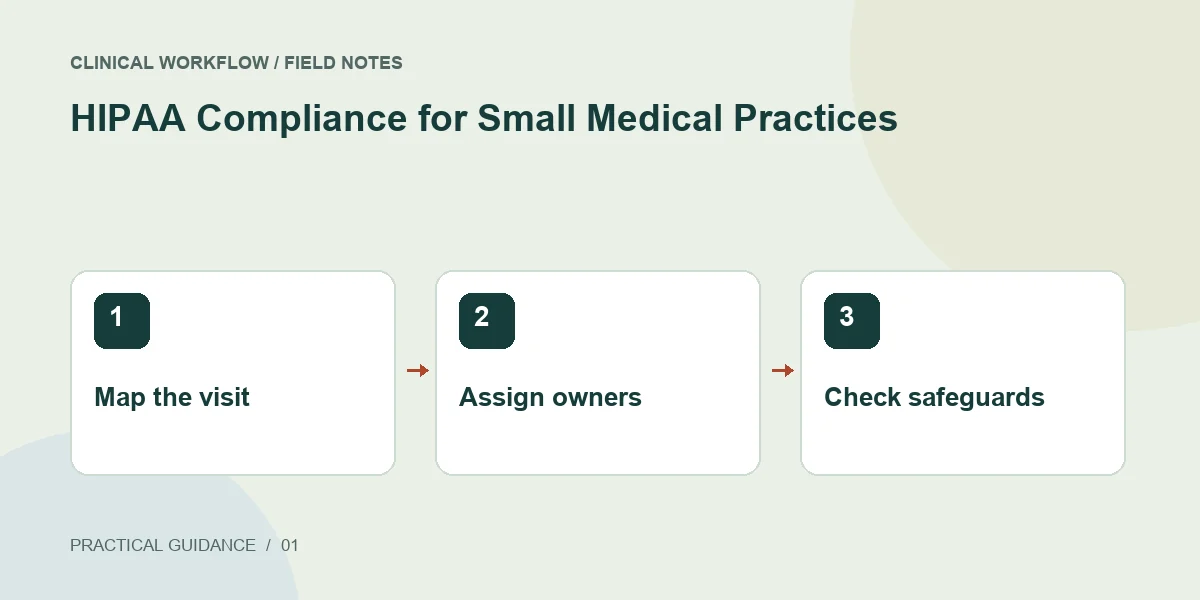
A two-room practice can move patient information through a dozen systems before lunch. Start by finding those systems, then make one person responsible for each handoff.
The practical answer
For a covered medical practice, HIPAA compliance means operating a continuing privacy and security program. Practice size changes how safeguards are implemented; it does not by itself remove the practice from HIPAA's scope.
Start with the patient information journey
Walk through a single fictional visit: an appointment request arrives, a receptionist confirms coverage, a clinician documents care, and a bill leaves the office. List the people, devices, software, paper records, and outside organizations involved. Include the printer, shared inbox, after-hours answering service, and home laptop that staff actually use.
This exercise is an operational starting point, not a substitute for the Security Rule risk analysis. Use the map to give the assessment a realistic scope. A cloud drive omitted from the inventory will also tend to be omitted from access reviews, incident planning, and vendor checks.
- Assign an owner to the information inventory and keep a dated version.
- Record where information enters, where it is stored, and who receives it.
- Separate clinical systems from experiments using invented patient examples.
Give privacy and security an owner
Name the people responsible for privacy and security, and make their responsibilities usable during a busy clinic day. Staff should know whom to contact when an email goes to the wrong address or a device disappears. An organizational chart is less useful than a clear route for reporting an actual problem.
As a practical management step, reserve a short recurring meeting for unresolved issues. Bring a list of access changes, vendor changes, training needs, and open corrective actions. Give each action a person and a target date rather than leaving it as a general intention.
Make access match the work
Review the tasks performed by reception, clinicians, billing staff, and temporary workers. Configure access around those tasks. Shared accounts make it difficult to establish who acted; individual accounts make joiner, mover, and leaver procedures easier to operate.
Test the departure process with a fictional staff member. Can the practice revoke the EHR account, email session, remote access, and vendor portal access using one checklist? Record gaps and fix the highest-impact ones first. Consider multifactor authentication for supported systems as a security measure, while checking the rules applicable to the actual deployment.
Check vendors before patient information moves
Under HHS guidance, a service provider that performs covered functions involving PHI on a practice's behalf may be a business associate. Where a BAA is required, arrange it before the relevant disclosure. An ordinary subscription agreement is not a substitute.
For vendor review, ask for the exact service name, enabled features, permitted uses, subcontractors, retention controls, and incident contact. Record what was reviewed. A sales page describing a secure platform does not establish the configuration used in your practice.
Introduce AI with a deliberately narrow pilot
Begin with work that can use fully fictional information: rewriting a generic instruction sheet, drafting a meeting agenda, or outlining an internal workflow. These trials let staff learn to inspect outputs without importing a real chart into an unapproved service.
Before allowing PHI, the responsible team should review the actual data path, applicable contractual arrangements, service settings, and safeguards. Include attachments, conversation history, prompt logs, support access, integrations, and exported outputs. Removing a patient's name alone does not establish HIPAA de-identification.
For an early documentation pilot, write down who may submit information, what they may submit, who reviews the draft, and where the final record belongs. Treat the AI output as a draft requiring clinical review. Track corrections as well as time spent; fast output that repeatedly needs repair may create more work.
Build a small evidence folder
Create a clearly organized folder for the risk analysis, corrective actions, relevant policies, vendor agreements, training records, and evidence of control checks. Avoid patient details in this administrative folder unless they are needed and appropriately protected.
Evidence should show what happened, not just what was planned. For example, retain a dated restoration-test result rather than a policy that merely says backups exist. Keep the decision and its rationale when choosing a safeguard. Check applicable documentation and medical-record retention rules separately; they are not interchangeable.
Choose a useful measure of progress
For a small practice, a useful dashboard can fit on one page. Consider counting unresolved access issues, overdue corrective actions, and workflows awaiting vendor review. Pair each count with the responsible owner and the next decision. Avoid treating the number of policies written as evidence that the policies work.
Use the dashboard to protect staff time: decide which single change will remove the most uncertainty from the next week of work. A completed account review or a rehearsed reporting procedure gives the team something concrete to rely on.
Use the next staff meeting to test one scenario
Ask the team what they would do if an employee pasted a clinical note into the wrong AI account. The useful answers identify an immediate reporting route, the person who preserves evidence, and the person who decides next steps. Do not let staff improvise deletion or patient notification without the response team's direction.
Finish with one improvement that can be completed this week. It might be removing a former worker's access, reviewing an unapproved tool, or clarifying where incident reports go. A manageable program grows through completed actions and verified routines.
Sources & scope
Primary references consulted October 22, 2026. Practical exercises and checklists are editorial implementation suggestions, not quoted legal requirements.
- HHS: Summary of the HIPAA Security Rule
- HHS: Business Associates FAQs
- HHS: Guidance on Risk Analysis
Educational content; not legal advice. Confirm current requirements for your organization and jurisdiction. Read our editorial and commercial disclosure.