Technology & AI · Practical field guide
What is HIPAA compliance for software developers
A helpful debug statement can become a second patient database. Developers need to review the places where information escapes the feature they intended to build.
The practical answer
Developers supporting a HIPAA-regulated service need to understand the organization's role and implement the safeguards relevant to their work. Software is one part of the program; policies, contracts, and operational responsibilities also matter.
Write data boundaries into the design
Describe what the feature receives, why it needs those fields, where it sends them, and when copies are removed. Include telemetry, error tracking, search indexing, analytics, and support access. Assign a reviewer to each external destination.
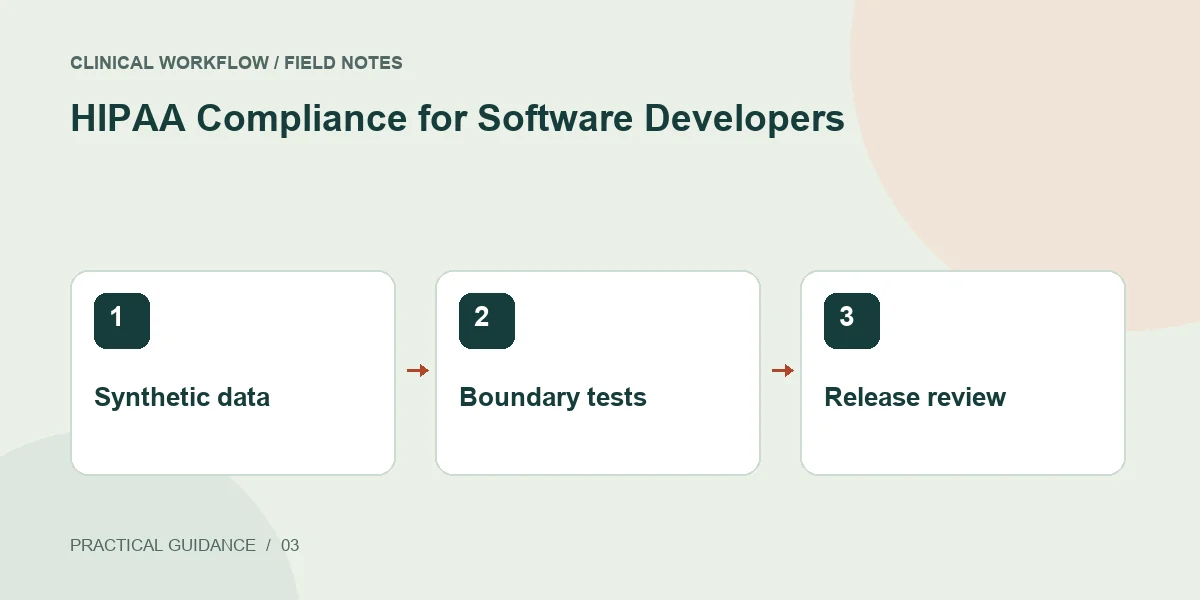
Use invented records in examples, automated tests, and issue reports. A production screenshot pasted into a ticket can carry information farther than the application request itself. Make the safe path easy by providing realistic synthetic fixtures.
Test permissions as behavior
Create scenarios for a clinician, a billing user, an administrator, and a departed employee. Test both permitted and denied actions, including direct requests for another patient's resource. Checking whether a menu item is hidden does not establish that the server rejects an unauthorized request.
For exports and background jobs, test the service identity separately. Review how credentials are stored, rotated, and revoked. Record what an operator should do when a scheduled job starts failing rather than encouraging emergency permission expansion.
Inspect the AI integration path
Before release, walk through an intentionally malformed request and an unavailable provider. Decide whether the system should stop, queue, or offer a manual workflow. A fallback to a personal AI account should never be an undocumented recovery mechanism. Keep the design decision and test evidence with the release record.
- Use synthetic prompts while developing and debugging.
- Review prompt and response logging at every layer.
- Check attachments, retrieval sources, and tool-call destinations.
- Document provider settings and approved service scope.
- Require a human review step before clinical use of generated text.
Sources & scope
Primary references consulted October 22, 2026. Practical exercises and checklists are editorial implementation suggestions, not quoted legal requirements.
Educational content; not legal advice. Confirm current requirements for your organization and jurisdiction. Read our editorial and commercial disclosure.