Technology & AI · Practical field guide
What is HIPAA compliance in cloud computing
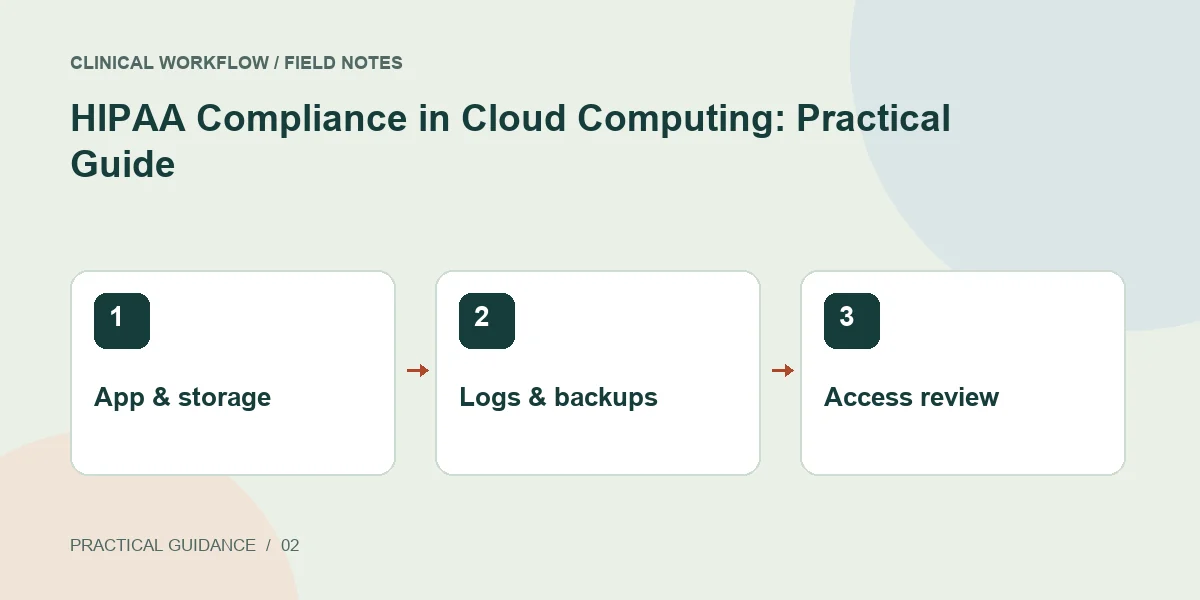
The database may be locked down while its nightly export sits in an overlooked storage bucket. A cloud review needs to follow copies, not just the main application.
The practical answer
Cloud HIPAA compliance concerns the organization's use of a service, its contractual arrangements, and its safeguards for ePHI. A vendor label alone does not establish that a particular deployment meets the applicable requirements.
Draw the deployment you actually operate
Start with a fictional record and trace the application, object storage, database replicas, backup jobs, monitoring, support tools, and connected AI services. Mark which team controls each component. Include nonproduction environments if they receive copies of production data.
Turn this drawing into a review agenda. Ask an engineer to demonstrate where request bodies, exceptions, and uploaded files appear. A configuration export can be more useful than a verbal assurance that logging is safe.
Resolve the contract and configuration separately
Where the provider acts as a business associate, the relevant BAA must address that relationship. Then verify the subscribed services and enabled features against the agreement. A signed document does not configure access permissions or backup retention.
Use a responsibility table with an owner, an implementation location, and evidence for each control. Include access administration, key handling, patching, monitoring, restoration, incident reporting, and secure disposal. Treat this table as an implementation aid rather than a certification.
Run a release exercise before PHI
Review results with the service owner. An unanswered question about an AI integration is a reason to keep that integration outside the PHI workflow until the question is resolved. Keep the findings with the risk assessment and repeat affected checks after material configuration changes.
- Attempt access using an account that should be denied.
- Restore fictional test data into an isolated environment.
- Check whether a failed API request exposes its body in logs.
- Confirm who can revoke an integration credential.
- Document the incident contact and escalation path.
Sources & scope
Primary references consulted October 22, 2026. Practical exercises and checklists are editorial implementation suggestions, not quoted legal requirements.
- HHS: Summary of the HIPAA Security Rule
- HHS: Business Associates FAQs
- HHS: Guidance on Risk Analysis
Educational content; not legal advice. Confirm current requirements for your organization and jurisdiction. Read our editorial and commercial disclosure.